


 RSS Feed (xml)
(KPL) The plain of jars is now the first tourist destination of Xiengkhuang province and it is expected to receive more than 20,000 foreign tourists in the year of 2009.
Mr. Khamphet Phommadouagkaison, Head of Tourism Department of Xiengkhuang said recently that his province has been working to improve many section of tourism, especially the infrastructure and accommodation to receive increased number of tourists. Today, the Xiengkhuang province has 93 surveyed tourism sites, 35 sites of which have already opened for service.
Mr. Khamphet added that the plain of jars which comprised with four main sites namely Plain of Jars, site 1 in Paek district, site 2-3 in Phaxay district and site 4 in Ban Phakeo, Paek district are the most attractive tourist sites in the province.
Besides the plain of Jars, the Xiengkhuang province has also a number of tourist sites to serve the local and foreign tourists. These included the hot spring in Khoun and Kham districts, eco-tourism site of Xang Cave, Kha, Peub and Lang waterfalls in Phaxay district
Showing posts with label world heritage. Show all posts
Showing posts with label world heritage. Show all posts
Sunday, January 18, 2009

Tuesday, November 25, 2008
Laos to request UNESCO recognition of Khammuan site
Laos plans to ask the United Nations' Educational, Scientific and Cultural Organisation (UNESCO) to designate a national protected area in Khammuan province as a world heritage site.
The area is known as Phou Hin Nam Nor ( Stone Pillar Mountain ) and covers an area of 82,000 hectares.
Phou Hin Nam Nor Head, Mr Sysomphone Southijack, this week said Laos made the request because the area was naturally beautiful and full of wildlife.
He said Phou Hin Nam Nor was added to the list of national protected areas in 1993, and is one of 21 such protected areas in Laos . The mountain is believed to have formed due to a volcanic eruption several centuries ago.
The government has listed Phou Hin Nam Nor and the Plain of Jars in Xieng Khuang province for submission to UNESCO for recognition as world heritage sites, Mr Sysomphone said.
“We believe the designation of Phou Hin Nam Nor as a world heritage site would help to attract more tourists to the province,” he said.
The protected area borders the Phong Nga-Kebang National Park in Vietnam , which was named a world heritage site by UNESCO in 2003.
Mr Sysomphone said it would be appropriate for UNESCO to include Phou Hin Nam Nor as an extension of this area of natural beauty.
The first place in Laos to be named a world heritage site was the picturesque and historic town of Luang Prabang , which was added to UNESCO's list in 1995.
In 2001 the Vat Phou temple in Champassak province was also added to the list. This temple is a fine example of early and classic Khmer architecture, dating from the 7th to 12th centuries A.D.
At the foot of Vat Phou lies the remains of the ancient city of Shestupura , first settled in the 5th century A.D and believed to be the oldest urban settlement in Southeast Asia .
By Meuangkham Noradeth
(Latest Update November 26, 2008)
http://www.vientianetimes.org.la/FreeContent/Curren_Laos.htm
Sunday, October 5, 2008
Tourists to Vat Phu increased by 5 per cent
(KPL) In the last 11 months this fiscal year around 30,000 visitors fro Europe, America and Asia have visited Vat Phu the second World Herritage of Champassak province.
The tourists from such origins is increased by five per cent compared to the same period last year.
A local tourism official said last week tourists from Europe, America and Asia shared the majority of Vat Phu's visitors.
Mr Khankham Kanbouta, the Head of Vat Phu Management Office said since last October around 53,800 tourists had visited the second World Herritage in the province. These included 19,257 domestic tourists and 34,627 foriegn tourists.
Champassak with the assistance from the government of France has improved the tourist site of Vat Phu and set up a project to preserve traditional handicrapt production of local people to attract greater number of tourists to the southernmost province.
The tourists from such origins is increased by five per cent compared to the same period last year.
A local tourism official said last week tourists from Europe, America and Asia shared the majority of Vat Phu's visitors.
Mr Khankham Kanbouta, the Head of Vat Phu Management Office said since last October around 53,800 tourists had visited the second World Herritage in the province. These included 19,257 domestic tourists and 34,627 foriegn tourists.
Champassak with the assistance from the government of France has improved the tourist site of Vat Phu and set up a project to preserve traditional handicrapt production of local people to attract greater number of tourists to the southernmost province.
Monday, June 30, 2008
Luang Prabang world heritage certifies as smoke-free town
(KPL) The World Health Organisation (WHO) has handed over a prestigious award to
Luang Prabang world heritage town of UNESCO to certify Luang Prabang province succeeded in the implementation of non-smoking area.
Luang Prabang is the first world heritage town has been successful in establishment of non-smoking area and promulgated as smoke-free area which has been approved by Luang Prabang Administrative Board considering as national historical event.
The award was handed over by a country representative of WHO to Laos to Luang Prabang Deputy Governor Khampheng Saysompheng in presence of Deputy Minister of Public Health Bounkhuang Phitchit and other high-ranking official concerned, on 26 June, Luang Prabang province.
The main of objective is to build Luang Prabang heritage town as smoking-free town and reduce breathing smoking caused by other severe disease.
Luang Prabang world heritage town of UNESCO to certify Luang Prabang province succeeded in the implementation of non-smoking area.
Luang Prabang is the first world heritage town has been successful in establishment of non-smoking area and promulgated as smoke-free area which has been approved by Luang Prabang Administrative Board considering as national historical event.
The award was handed over by a country representative of WHO to Laos to Luang Prabang Deputy Governor Khampheng Saysompheng in presence of Deputy Minister of Public Health Bounkhuang Phitchit and other high-ranking official concerned, on 26 June, Luang Prabang province.
The main of objective is to build Luang Prabang heritage town as smoking-free town and reduce breathing smoking caused by other severe disease.
Wednesday, March 5, 2008
Vat Phou festival marks growing attraction
The country's second World Heritage Site is celebrating its annual traditional festival with a range of colourful activities.
 |
A view of some of the ancient structures in the Vat Phou area. |
The UN Education, Scientific and Cultural Organisation (UNESCO) added Vat Phou to its list of UNESCO World Heritage Sites in 2001. The first such site in Laos is the ancient city of Luang Prabang , added to the list of world cultural attractions in 1995.
Last year provincial authorities celebrated the 5 th anniversary of Vat Phou's addition to the UNESCO list. More than 1,000 senior officials, local residents and foreign visitors attended the event.
This year's programme activities include religious rituals and locally organised activities, according to the Head of the Ancient Research Unit in Champassak province, Mr Bounlap Keokanya, and the Governor of Champassak district, Mr Sipaseuth Sengsavath.
The festival runs from February 16-21.
Mr Sipaseuth said a trade fair was being held to display and sell products from various villages, districts and companies.
Visitors would be able to explore the Vat Phou temple complex, built at the end of the 5 th century. The final day of the festival will see an alms offering ceremony, held in the early morning at Vat Phou, where hundred of monks will bestow blessings on merit-makers.
Mr Bounlap said Vat Phou was an important and meaningful place for the province. Its special place in history is based on various cultural sites, leading UNESCO to approve its addition to the World Heritage list in 2001.
According to UNESCO, Vat Phou is an outstanding example of the integration of a symbolic landscape of great spiritual significance with its natural surroundings.
The layout of the site is contrived to express a Hindu vision of the relationship between nature and humanity. Vat Phou exhibits a remarkable complex of monuments from different periods of time and different religions that made use of the site, spread over an extensive area between the river and a hill. The hill itself was selected for religious reasons, because of the phallic shape of its rocky peak, and the location of a natural spring at the top.
Mr Bounlap explained that Vat Phou has outstanding architecture, with many great works of art carved into its walls. Sculptures and inscriptions from the site are now displayed in the museum that lies at its base.
“The Vat Phou temple complex and the landscaping to be found in surrounding areas of Champassak are remarkably well preserved, reflecting a plan more than 1,000 years old,” he said.
He said the Hindu vision of the relationship between nature and humanity was based around an axis drawn from the mountain top to the riverbank, laying out a geometric pattern of temples, shrines and pools extending over some 10 km.
Two planned cities on the banks of the Mekong River are also part of the site, as well as Phou Kao Mountain .
This magical landscape covers about 390 square kilometres, on the right bank of the Mekong River . It includes the remains of an ancient city, the remains of the foundations of tall structure with pillars, a nang sida hall, a thao tao hall and a group of stone temples on Vat Phou itself.
The ancient city covers 400 hectares of Champassak district, according to Mr Bounlap.
Vat Phou is an excellent example of classic Khmer and Cham decorative architecture. At the foot of Vat Phou is the ancient city of Shestupura , first settled in the 5 th century AD, one of the oldest urban settlements in Southeast Asia .
Mr Bounlap said the group of stone temples on Vat Phou was an important reference point in the two periods of Khmer architecture in the 7 th and 12 th centuries. They were built on a hillside, which was very rare in Khmer architecture and ran along an east-west axis over 1,400 metres.
The provincial authorities, in conjunction with local residents, organise the festival in February each year, when people come from around the world to pay respect to a place that is highly revered in the south of Laos .
By phon thekeo
(Latest Update Febuary 18, 2008)
Monday, February 18, 2008
Guesthouses fully booked for Vat Phou festival
Guesthouses and hotels are now booked out in Champassak district of Champassak province, as crowds of people prepare to descend on the town to celebrate the Vat Phou festival from February 19 to 21.
Gov ernor of Champassak district Sipaseuth Sengsavath said yesterday that visitors without reservations may have to stay overnight in nearby Pakxe to be able to enjoy the festivities.
Provincial tourism office head Mr Sivone Vongkonevilay confirmed that there were still rooms available at hotels and guesthouses in Pakxe, but said he could not confirm whether this would be the case during the event itself.
In the meantime, Champassak district authorities have announced they will deploy forces to ensure traffic flows smoothly and to minimise congestion and road accidents.
“We have improved the road to Vat Phou and enlarged ferry landings on the Mekong to facilitate the transport of vehicles across the river,” Mr Sipaseuth said.
Authorities estimate that at least 30,000 people a day will visit Vat Phou during the three-day festival, and that people will begin to arrive as early as February 16.
A trade fair will be held during the event to display and sell products from villages, districts and companies, as part of efforts to encourage local production; so far, more than 100 booths have been booked.
Last year, Champassak provincial authorities held the Vat Phou festival to coincide with the fifth anniversary of the declaration of the temple as the country's second World Heritage-listed site.
District authorities generated 200 million kip from traders and visitors during the trade fair, and villagers were also able to profit.
“We hope the number of tourists will not be less than last year,” Mr Sipaseuth said.
Programme:
February 19
District governor Sipaseuth Sengsavath will deliver a speech to officially open the festival in the morning and will talk about the aim of the festival - to encourage unity among villagers.
In the evening, a sports competition will be held at the Vat Phou esplanade, which will be an important event to select district athletes for the National Games at the end of this year.
There will also be a cultural performance, bringing together artists from Champassak district and province, alongside the popular Japanese band Gypsy Queen.
February 20
Visitors will be able to explore the Vat Phou temple complex, built at the end of the 5 th century, and learn more about the history of this intriguing site at the nearby museum.
The sports contests and performances will continue, showcasing artists from India and Japan .
February 21
An alms offering ( taak baat ) ceremony will be held early in the morning at Vat Phou, where hundreds of monks will chant blessings to merit-makers.
The continuing sports contest will include traditional games; there will also be a candlelight procession and more cultural performances.
By VIENTIANE TIMES
(Latest Update February 13, 2008)
Gov ernor of Champassak district Sipaseuth Sengsavath said yesterday that visitors without reservations may have to stay overnight in nearby Pakxe to be able to enjoy the festivities.
Provincial tourism office head Mr Sivone Vongkonevilay confirmed that there were still rooms available at hotels and guesthouses in Pakxe, but said he could not confirm whether this would be the case during the event itself.
In the meantime, Champassak district authorities have announced they will deploy forces to ensure traffic flows smoothly and to minimise congestion and road accidents.
“We have improved the road to Vat Phou and enlarged ferry landings on the Mekong to facilitate the transport of vehicles across the river,” Mr Sipaseuth said.
Authorities estimate that at least 30,000 people a day will visit Vat Phou during the three-day festival, and that people will begin to arrive as early as February 16.
A trade fair will be held during the event to display and sell products from villages, districts and companies, as part of efforts to encourage local production; so far, more than 100 booths have been booked.
Last year, Champassak provincial authorities held the Vat Phou festival to coincide with the fifth anniversary of the declaration of the temple as the country's second World Heritage-listed site.
District authorities generated 200 million kip from traders and visitors during the trade fair, and villagers were also able to profit.
“We hope the number of tourists will not be less than last year,” Mr Sipaseuth said.
Programme:
February 19
District governor Sipaseuth Sengsavath will deliver a speech to officially open the festival in the morning and will talk about the aim of the festival - to encourage unity among villagers.
In the evening, a sports competition will be held at the Vat Phou esplanade, which will be an important event to select district athletes for the National Games at the end of this year.
There will also be a cultural performance, bringing together artists from Champassak district and province, alongside the popular Japanese band Gypsy Queen.
February 20
Visitors will be able to explore the Vat Phou temple complex, built at the end of the 5 th century, and learn more about the history of this intriguing site at the nearby museum.
The sports contests and performances will continue, showcasing artists from India and Japan .
February 21
An alms offering ( taak baat ) ceremony will be held early in the morning at Vat Phou, where hundreds of monks will chant blessings to merit-makers.
The continuing sports contest will include traditional games; there will also be a candlelight procession and more cultural performances.
By VIENTIANE TIMES
(Latest Update February 13, 2008)
Wednesday, January 16, 2008
Vat Phou needs room to display 2,000 artefacts
 The exhibition hall at the World Heritage Site of Vat Phou in Champassak province is unable to display some 2,000 artefacts due to a lack of space, the Director of the Vat Phou Heritage Office, Mr Khankham Kaenboutta, said on Tuesday.
 The artefacts remain in storage because there is no display space left in hall, he said.
The exhibition hall is used to display archaeological remains found within the World Heritage site.
“This year we hope to build more rooms in the hall so that we can exhibit some of the most significant historic materials that are now in storage,” Mr Khankham said.
Vat Phou has received donations from visitors for this purpose, after they learned of the shortage of space when they visited the site.
Last year more than 50,000 visitors came to Vat Phou and it is expected that the number will increase to 70,000 this year.
Currently the only direct revenue generated by the site is from the entrance fees to the temple complex and exhibition hall: 30,000 kip for foreigners and 3,000 kip for Lao people.
Fifty percent of the revenue goes to the central government and the remaining 50 percent is used for site management.
The goal of the local government is to retain 90 percent for preservation of the site and to hand over the remaining 10 percent to the central government.
The French government will provide around 1 million euros from its Fonds de Solidarite Prioritaire (Priority Solidarity Fund) from 2007-10, in support of three activities carried out under the Vat Phou development project.
The first of these is a field study to identify how best to improve the site for tourism. The second is to improve infrastructure around the heritage site to assist better visitor management, and the final stage will be the training of personnel in conservation and site management.
This month the Italian government provided US$25,000 to Vat Phou officials for maintenance of the complex.
To reach Vat Phou, most visitors travel south from Pakxe on Route 13, turning right at a small village known as Kilometre 35 or Laksamsipha, and travel another 3 kilometres to reach the banks of the Mekong .
They then take a ferry at Muang village in Pathoumphon district, which takes them to the small town of Champassak on the other side, about 12 kilometres from the temple site.
The exhibition hall, funded by the Japanese government through the Japan International Cooperation Agency, was built just inside the main gate of the temple complex in 2003.
By Khonesavanh Latsaphao
http://www.vientianetimes.org.la/Previous_008/Current/Current_vat.htm
(Latest Update January 10, 2007)
Monday, October 1, 2007
UNESCO to review Luang Prabang's World Heritage status
UNESCO will send officials to Luang Prabang next month to see whether the town still warrants its World Heritage status, according to a senior official.
The head of the Luang Prabang Heritage Office, Ms Manivone Thoummabouth, said last week that the team of inspectors would arrive in Luang Prabang early next month, and will work there for two weeks to review all heritage sites in a routine inspection.
“They will come with a checklist to ensure all listed building and artefacts have remained intact in the 10 years since the town was listed as a World Heritage Site,” she said in a telephone interview with Vientiane Times.
She said the inspection was not unexpected, because UNESCO inspects all sites 10 years after they have been granted World Heritage status.
She added that UNESCO had proposed an inspection of the town last year. “Lao government and UNESCO officials reached an agreement on a deadline for the Luang Prabang inspection in August during a meeting in Switzerland ,” she said.
Ms Manivone said the team of inspectors had extensive knowledge of World Heritage Sites and remained independent from all state organisations.
UNESCO has removed certain sites from the World Heritage list in the past, including the city of Chiang Mai in Thailand , which was unable to maintain its sites due to rapid development.
Ms Manivone said she had a strong belief that the results of this year's inspection would be positive, because over the past 10 years local authorities have “done an excellent job in maintaining the area”.
She explained that many of the town's temples and houses were in the same condition as they were 10 years ago, and all renovations had been carried out carefully, in accordance with heritage guidelines.
She also said that while local architecture had been preserved, Luang Prabang residents had continued to maintain their traditional lifestyles; women still wear the traditional Lao skirt when offering alms to monks in the early mornings, an example of the many traditions that have largely disappeared in Asia .
Ms Manivone said the Lao government has always been intent on protecting its places of cultural heritage as they reflect the unique Lao culture, and help to boost the tourism industry.
“Many tourists come to Luang Prabang because of its World Heritage status,” she said, adding that this has led to more jobs and better incomes for local people.
By VIENTIANE TIMES
(Latest Update October 02, 2007)
The head of the Luang Prabang Heritage Office, Ms Manivone Thoummabouth, said last week that the team of inspectors would arrive in Luang Prabang early next month, and will work there for two weeks to review all heritage sites in a routine inspection.
“They will come with a checklist to ensure all listed building and artefacts have remained intact in the 10 years since the town was listed as a World Heritage Site,” she said in a telephone interview with Vientiane Times.
She said the inspection was not unexpected, because UNESCO inspects all sites 10 years after they have been granted World Heritage status.
She added that UNESCO had proposed an inspection of the town last year. “Lao government and UNESCO officials reached an agreement on a deadline for the Luang Prabang inspection in August during a meeting in Switzerland ,” she said.
Ms Manivone said the team of inspectors had extensive knowledge of World Heritage Sites and remained independent from all state organisations.
UNESCO has removed certain sites from the World Heritage list in the past, including the city of Chiang Mai in Thailand , which was unable to maintain its sites due to rapid development.
Ms Manivone said she had a strong belief that the results of this year's inspection would be positive, because over the past 10 years local authorities have “done an excellent job in maintaining the area”.
She explained that many of the town's temples and houses were in the same condition as they were 10 years ago, and all renovations had been carried out carefully, in accordance with heritage guidelines.
She also said that while local architecture had been preserved, Luang Prabang residents had continued to maintain their traditional lifestyles; women still wear the traditional Lao skirt when offering alms to monks in the early mornings, an example of the many traditions that have largely disappeared in Asia .
Ms Manivone said the Lao government has always been intent on protecting its places of cultural heritage as they reflect the unique Lao culture, and help to boost the tourism industry.
“Many tourists come to Luang Prabang because of its World Heritage status,” she said, adding that this has led to more jobs and better incomes for local people.
By VIENTIANE TIMES
(Latest Update October 02, 2007)
Friday, September 14, 2007
Wat Phou: The Sanctuary
 There is a long way behind the trees to go to the sanctuary and we need to climb up the hill.
After getting up the hill we can look back how far we have walked from the palaces.
 Now we can enjoy the art of Sanctuary's walls and doors
 Another view of the Sanctuary
Wednesday, September 5, 2007
Wat Phou: The King Kammatha
Continuing west, successive staircases lead up further terraces; between them stands a dvarapala which has come to be worshipped as king Kammatha, mythical builder of the temple. On the narrow next terrace are the remains of six small shrines destroyed by treasure-hunters.
.JPG)
.JPG)
Monday, August 27, 2007
Wat Phou: causeway

This is a map of Wat Phou area. We started our journey from the palaces which are on the right. We continue our journey from palaces through a causeway to the first step.

The palaces are behind.

The close look of stone columns (ເສົາເສ)

And the first step. Stone columns are behind
Monday, August 13, 2007
Wat Phou: The palaces
 The large sign is welcoming us to the second world heritage place in Laos and its cerebration festival for the fifth anniversary of being the world heritage place.
 The bazaar in front of the festival
 My pictures are not good enough in strong sun light. This is North Palace.
 We still will be in Wat Phou in the next posts. We will take a long walk from Palaces to the cliff.
Friday, August 10, 2007
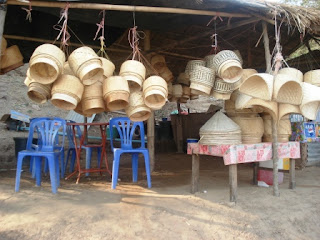
Local handicraft on the way to Wat Phou
To go to Wat Phou I decided to use road no 13th which need to cross the Mekong using ferries.
As your vehicle reached the river bank you will see a lot of handicraft shops along the road..JPG)
.JPG)

.JPG)
.JPG) If you don't know what are they or what are they for, you just buy as souvenir.
If you don't know what are they or what are they for, you just buy as souvenir.
As your vehicle reached the river bank you will see a lot of handicraft shops along the road.
.JPG)
.JPG)

.JPG)
.JPG) If you don't know what are they or what are they for, you just buy as souvenir.
If you don't know what are they or what are they for, you just buy as souvenir.Saturday, July 21, 2007
Wat Phou: Crossing the Mekong
I went to Wat Phou two times. The first time in 2005. I went there in the evening. We started from Tomo at 7 p.m and we reached Wat Phou at 11 p.m. because of traffic jam. The road was full of vehicles and crowd heading to Wat Phou festival which is held once a year. The vehicles must cross the Mekong using ferries, there were about ten of them going from one bank to another. It was dark that night, I could not take photo to show here.
But I have another pictures taken in the day time during my second trip to Wat Phou.


In the ferry you can find noodle soup to eat and if you have motorbike and you don't prefer big ferries then choose the choice shown in the last picture
But I have another pictures taken in the day time during my second trip to Wat Phou.


In the ferry you can find noodle soup to eat and if you have motorbike and you don't prefer big ferries then choose the choice shown in the last picture
Tuesday, July 17, 2007
Tomo: The world heritage of Tomo
If you begin from Pakse and going south, you will find Tomo at kilometer 40.
You will find the sign on the rightside. Turn right and go along unpaved road about 1 kilometer (could not remember exact distance).
There is a kiosk for tourists for buying tickets but the day I went there I could not find anybody who sells tickets.
Among the high trees you will see the stone ruins of Ancient Khmer empire like in Angor Wat.


People may know Wat Phou which is also the ancient Khmer architecture better than this place.
You will find the sign on the rightside. Turn right and go along unpaved road about 1 kilometer (could not remember exact distance).
There is a kiosk for tourists for buying tickets but the day I went there I could not find anybody who sells tickets.
Among the high trees you will see the stone ruins of Ancient Khmer empire like in Angor Wat.


People may know Wat Phou which is also the ancient Khmer architecture better than this place.
Subscribe to:
Posts (Atom)

